For decades, the physical desk has been the anchor of professional productivity. We measured our efficiency by the number of monitors we could fit on a tabletop and the ergonomic quality of our chairs. However, as we move through 2026, the very definition of a “workspace” is being rewritten. We have entered the era of Augmented Productivity, where the constraints of physical hardware are replaced by the infinite flexibility of spatial computing. With the latest generation of AR glasses and mixed-reality headsets, the world itself has become a high-resolution canvas. From a cramped airplane tray to a kitchen island, every surface is now a potential multi-monitor workstation.
The Death of the Desk: Freedom Through Spatial Computing
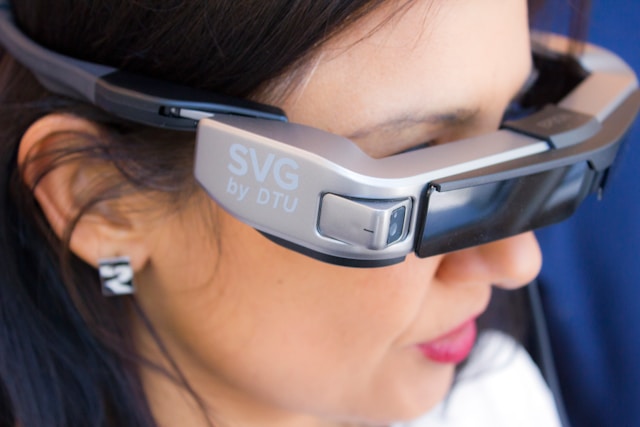
The primary driver of augmented productivity is the decoupling of the display from the device. Historically, a triple-monitor setup required a massive desk, monitor arms, and a complex web of cables. In 2026, a pair of lightweight AR glasses—often weighing less than 80 grams—can project a 130-inch virtual ultrawide display or three independent floating 4K monitors into your field of vision.
This shift has profound implications for the modern mobile professional. The “digital nomad” of 2026 no longer sacrifices screen real estate for portability. Whether in a hotel lobby or a public park, a worker can “anchor” their windows to the physical environment. Using advanced Spatial Anchoring and Simultaneous Localization and Mapping (SLAM) technology, these virtual screens stay locked in place relative to the real world. You can have your email pinned to the wall on your left, your primary document floating directly in front of you, and a research browser hovering above your coffee cup. When you turn your head, the workspace remains stable, mimicking the reliability of physical monitors without the bulk.
Auto-Spatialization: Bridging the 2D and 3D Worlds
A key technological breakthrough in 2026 is “Auto-Spatialization,” popularized by the Android XR platform and Meta’s latest OS updates. In the early days of AR, users were limited to specific apps designed for 3D space. Today, AI-driven systems can take almost any traditional 2D application and automatically add depth, parallax, and spatial presence.
This means your standard spreadsheet, video editor, or coding environment is no longer a flat image. As you tilt your head, you can see “behind” the UI elements, and windows can be layered in 3D space to reduce visual clutter. This cognitive offloading allows for more natural multitasking; instead of “alt-tabbing” through a stack of overlapping windows on a single laptop screen, you simply glance to your right to check a reference or look up to see your calendar. This mirrors how the human brain naturally processes information in the physical world, leading to a measurable decrease in “mental context-switching” fatigue.
Ergonomics 2.0: The End of the “Tech Neck”
Traditional workstations, while functional, have long been a source of physical strain. “Tech neck” and repetitive strain injuries are often the result of being forced to conform to the fixed position of a monitor and keyboard. Augmented productivity flips the ergonomic equation: the workspace conforms to the user.
In an AR-driven environment, the concept of a “fixed” monitor is gone. You can adjust the height, tilt, and distance of your virtual screens to perfectly match your posture in real-time. If you want to work while standing, the screens rise with you. If you prefer to lean back in a comfortable chair, the screens can be tilted to stay perfectly in your line of sight. By allowing for a dynamic range of movement throughout the workday, spatial computing is actively reducing the sedentary strain of the traditional office.
The Collaboration Revolution: Shared Spatial Context
Perhaps the most transformative aspect of augmented productivity is how it handles collaboration. Traditional video calls—the “heads in boxes” model—notoriously lack shared context. In 2026, spatial computing has introduced “Embodied Presence.”
Using high-fidelity avatars and shared 3D environments, remote teams can now “cowork” on the same digital assets as if they were in the same room. A design team can gather around a 3D CAD model floating in the center of their respective home offices. Each participant sees the model from their own perspective, can point to specific components, and make annotations that everyone else sees instantly. Research has shown that this shared spatial context leads to 28% better content recall and 31% less meeting fatigue compared to standard video conferencing. It turns a “meeting” back into a “workspace.”
Privacy and Focus in Public Spaces
One of the hidden benefits of the AR workstation is the “Privacy of the Lens.” When working on a traditional laptop in a public area like a train or an airport, your screen is visible to anyone walking by. For professionals handling sensitive data or proprietary information, this is a significant security risk.
In a screenless AR setup, your work is invisible to the world. To a passerby, you are simply someone wearing a pair of glasses and perhaps using a compact keyboard. The “Digital Sanctuary” of your multi-monitor setup exists only for you. Furthermore, many AR devices now feature “Focus Modes” that can digitally dim or blur the real-world periphery, allowing you to create a “deep work” bubble even in a chaotic or visually distracting environment.
Hardware Convergence: The Rise of the NPU-Powered Laptop
The transition to augmented productivity has been accelerated by the evolution of the laptop. In 2026, we have seen the rise of “Screenless Laptops” and “Copilot+ PCs” optimized for spatial computing. These devices ditch the traditional lid and screen entirely, serving instead as a high-powered compute puck with an integrated keyboard and trackpad.
Driven by powerful Neural Processing Units (NPUs), these machines handle the 6DoF (Six Degrees of Freedom) tracking and spatial rendering required for a stable AR experience without sacrificing battery life. The laptop has transformed from being the “display” to being the “engine” for the glasses. This convergence allows for a lighter, more durable, and more portable hardware stack that provides a far more powerful experience than a tablet or a traditional ultrabook.
The Challenges of Field of View and Visual Fatigue
Despite the rapid adoption, the journey toward total augmented productivity still faces technical hurdles. The “Field of View” (FoV) remains a primary constraint. While high-end enterprise headsets offer expansive views, consumer-grade AR glasses often have a smaller “window” in which the virtual monitors appear. This means that while you can have an infinite number of screens, you can only see a few of them at any given moment.
Furthermore, “Vergence-Accommodation Conflict”—the eye strain caused by the brain perceiving depth that isn’t physically there—remains a focus for developers. The 2026 generation of optics has made significant strides in “Varifocal” displays that more naturally mimic how human eyes focus, allowing for longer work sessions with less discomfort.
Conclusion: The Future is Spatial
The era of being tethered to a physical monitor is coming to an end. Augmented Productivity represents a move toward a more human-centric, flexible, and efficient way of working. By turning every surface into a high-functioning workstation, technology is finally stepping out of the way and allowing us to work wherever and however we feel most inspired.
As AR hardware continues to shrink in size and grow in power, the distinction between a “home office” and the rest of the world will continue to blur. In the professional landscape of 2026, your office isn’t a place you go—it’s a perspective you put on. The future of work isn’t confined to a desk; it is as vast as the world around you, anchored only by your imagination and the technology that brings it to life.